One of the Monday morning sessions at #ERC2014 covered various elements of security and risk management. Starting off with Trygve Lauritzen, the Head if Security and Operations at Munch Museet, Norway, followed by Simon Mears a Security Consultant from Denmark and finishing with Pascal Matthey, from XL Group, Switzerland.
This was a extremely useful session. For many registrars these outlined threats and risk assessments are known, however, speaking to attendees after the session we all felt this was a useful refresher which reenforced to us how very real these threats are and the importance of why do things the way we do. Importantly we were also given glimpses into future possible risks to be aware of.
As experienced security professional and working at the Munch Museet Trygve gave a very practical and relevant talk on security for a museum registrars perspective. This talk was structured around four main points - transport security, general threats, future threats and document security.
Transport Security: provided some good statistical information behind his case studies, including the points where art is at most risk which is while in road transit and in a stationary vehicle. Art is 1000 times more at risk during road transport than it is in airfreight. Trygve also stressed the importance of planning transport routes, overnight stops, back up plans if your truck is running behind schedule and where breaks will be made. Also, stressed the importance of agents drivers to be fully briefed on contingency plans -i.e. if pulled over do they know what to do, eg Trygve firmly suggests that in such instance drivers should not fully open their windows, even if pulled over by police, as there are cases of fake police hijacking. For these and other such instances there should be clearly set out communication for the drivers, including numbers of the the relevant police / security staff. Munch Museet security for transit includes sealing the doors of trucks with unique numbered seals which are checked at point of departure and destination to show they have not been tampered.
General Threats:Following transit, organised crime is our biggest threat, whereby art can be used as payment. We need to be vigilant to ensure insider information has mot been exposed, consistent routine instructions which all staff are instructed on.
Future Threats:Our future threats include the continuation of organised crime which may become more violent, infiltration via insiders, tampering of GPS and surveillance systems.
Document Security: stressed the importance of document security as part of our overall security strategy. The following should, as we know as registrars be treated as confidential and be protected - values of art, names of the owners of art in your possession, transportation times. At Munch Muset document security is part of IT security and strategy, whereby protected documents are encrypted through a strong password.
Simon Mears presentation was based around Grasp, which is a standard or risk management to further safeguard collections and artefacts for the future. It is a standard used by Lloyds European Insurers but is also now widely used by institutions. Grasp came about following the Momart warehouse fire and Munch Museet theft and was started in 2005, at which point 24 unwritters supported this standard.
Grasp itself works through a detailed tailored assessment of over 1,200 questions and takes approximately 3 hours to complete. It is in a yes or no format. Grasp uses a holistic approach to risk assessment, looking at natural environment, buildings, political environment and management. The latter should include disaster planning, training of staff on what to do in the event of an alarm, access and key controls. For museums this assessment would also specifically look at admissions policies and procedures, private functions, event staffing and food service whereby fire is an element of risk. In developing its work with institutions, Mear informed us that through Grasp they are working with various government indeminity schemes, and looking at common bench marks.
An underlining concern that Grasp has identified are the growing number of loans and shortage of secure suitable storage facilities.
The final part of this section on security was presented by Pascal Matthey. This section concerned itself with holistic risk management specifically for museums. Simular to that of Grasp assessment, through an holistic approach, the risk families identified as part of a risk register were - natural hazards, internal and external ie transport and stragical.
When undertaking this assessment Matthey told us first to consider the context, then assess the threats (risk drivers), audit your existing profile, determine extent if the risk and then respond to mitigate risks through moreover treatment of these risks. Worse case loss should be considerd when undertaking this risk assessment, the Maximum Foreseeable Loss or the MFL, is the largest monetary loss that may be expected from a single incident at any given point. So it is best to look at points of maximum exposure.
When undertaking a risk analysis of internal and external threats using brainstorming top risks are theft and robbery, then fire. When undertaking the assessment think about what that individual or persons would need to do to get physically into the building , what skills, knowledge and equipment would they need.
When however undertaking a risk assessment of natural perils, the threats a less predictable. 90% of incidents are caused by electrical or technical failure, in such cases the MFL can reach 100% loss. The final threat Matthey briefly mentioned was terrorism, but this now an unlikely risk.
Matthey also showed ERC audience other risk assessment models, including one based on probability, whereby the idea is to slice risk down into separate, manageable parts. Here the main risk elements are fire, water and theft. With this risk model, the areas where these risks are likely are mapped out onto a plan of the institution. For instance with water risk is most likely in the basement or roof from leaking or flooding, with fire, consider what would burn first and where would it start and how easily would it travel? For theft it would be the most attractive work. Using this model allows a more likely MFL model.
Samantha Cox
UKRG web officer
Registrar, Tate St Ives

Please note UKRG blog posts include contributions from outside of the UKRG, any views expressed are those of the author and not necessarily the Committee or in case of posts on events the views of the speaker. For copies of presentations please go to the UKRG website.
Sunday, 15 June 2014

Friday, 13 June 2014
Assessing Risk in Lending and Borrowing
Monday afternoon’s topic covered the very relevant topic of assessing risk in lending and borrowing.
The session was kicked off by our very own Kate Parsons, Head of Collections Management at Tate and Jane Knowles, Chair of UKRG with their presentation:
“I look forward to hearing from you”: A lending and borrowing scenario.
As the title indicates, the session discussed a scenario in which several works were being requested from Tate for an exhibition by the Royal Academy, showing the point of view of both the lender and the borrower. They cleverly illustrated how each party must consider practical, logistical, legal, financial and reputational risks. As is sometimes the case with loan requests, in the scenario this did not go quite as smoothly as either organisation had perhaps hoped, and served to highlight the potential pitfalls when lending and borrowing.
Kate and Jane advocated a risk assessment based approach to lending, which they had found to work well at Tate.
As someone who is relatively new to the Registrar role, the session was really helpful in highlighting the key risks in lending and borrowing, but also the need for both parties to act in the interest of the work(s) and be realistic, practical and flexible when agreeing and implementing a loan. The closing message was one we should all perhaps take note of, that it is increasingly important for the lender and borrower to work together to mitigate risk, to illiminate actual problems as well as perceived ones.
The second fantastic session on the topic was given by Eva-Lena Bergstrom, Department Director at Nationalmuseum, Sweden. Her topic was entitled:
Lending and Borrowing – Calculating Risks.
This session also highlighted the need to remove the barriers to co-operation between museums and to encourage the mobility of collections for public benefit. In order to achieve this, Eva-Lena argued the need to reduce costs, currently so high that they often impede all but the large National museums. She suggested that there were four key issues which could address this:
• Improving indemnity schemes
• Improving valuation processes
• Simplifying risk assessments
• Making transport procedures more reliable and less expensive
The session drew upon the work done in the EU OMC Risk Assessment Group, 2010-2012. The over-riding message was to ask ourselves for what benefit are we acting when considering a loan: the object, the museum, the private interests or the public?
Panel Discussion
Perhaps unsurprisingly these two sessions led to a lively panel discussion which drew upon the Web Poll questions asked prior to the conference about risk assessment. The poll questions concerning uninsured liability sparked the most discussion. The practice of loan agreements asking a borrower to accept liability for damage to a work up to six months after the work has returned was highlighted, in particular the need for wording to be clear to establish if it is referring to any damage, or damage which occurred during the loan that only becomes apparent after its return. The panel discussion ended with the message that we need to recognise that the lender must take on some risk in order to provide access and that we need to shift away from the idea that the borrower must accept all risks.
On a personal note, I had a fantastic time at ERC 2014 and felt that this topic was one of the highlights of the conference. Both sessions drew heavily on the speakers excellent knowledge of the sector, were highly relevant and provoked a great panel discussion.
Many thanks to Jane, Kate and Eva-Lena.
ERC Helsinki: An overview
As a member of the UKRG Committee I was fortunate enough to attend the brilliantly organised ERC in Helsinki. From the conference itself to boat trips, Moomins and the Finnish Male Screaming Choir it was both entertaining and extremely informative, not only in registrarial issues, but also in the nuances of the wonderful Finnish culture. I’ve come away feeling better informed about so many issues, but also having met and networked my way around a plethora of interesting, engaging and inspiring colleagues. As someone who does not work with loans I was worried that it would be too loans and exhibitions focused, however, the sessions provided were all encompassing and very accessible and so I have come away with a new perspective on all aspects of the registrar's work. In particular, I learnt a lot about couriering and how the role of the courier is a finely tuned balancing act between providing the upmost care to the object in question as well as being a project manager, institution representative, problem solver, and documenter at the same time as respecting other cultures and colleagues across the globe. No mean feat!
Another session that stimulated me was the brilliant one by Kate Parsons and Jane Knowles – their ‘real’ case study approach was extremely educational and highly engaging. Their representation of how to manage risks in lending and borrowing through the use of an imagined real case with emails, letters and phone call transcripts created a real sense of the various elements in a registrar's job and the way that risk should and can be properly managed. This was then followed on by Eva-Lena Bergström who spoke about calculating risks for lending and borrowing, focusing specifically on practical ways of reducing costs of lending and borrowing cultural objects within the EU member states and the EU collection Mobility 2011-14. This has a focus on improving and expanding indemnity schemes, improving valuation processes, simplifying the process of risk assessment, and making the transport procedure more reliable and less expensive. I was astonished to learn that over the last 5 years 2,296 exhibitions have been covered by state indemnity in Europe and out of those only 16 cases of damage were claimed for at least 100,000 cultural goods borrowed, a tiny percentage of less than 0.016%. I came into the conference not knowing that much about state indemnity and I left realising what a powerful and amazing resource it is for museums across Europe.
For me, one of the themes tied across the whole conference was collaborative working not only between departments within their own institution but also between different institutions, transport agents, countries and external organisations. A great example of this was given by Christopher Marinello from Art Recovery International who gave a fascinating talk about art theft and recovery. I thought it was amazing that ArtNet has image recognition software which should make art recovery a bit easier in cases where there is an image of a lost artwork, no matter how bad, dark, grainy, or inconclusive it is to the human eye – seems a great idea to use technologies that are already in use in the policing world and adapt these for art theft reasons. Another great example is that of the case of the Metropolitan Museum in New York and the Louvre and the fact that they came to an agreement in 1974 to reunite the head and body of a neo-Sumerian statue. To do this they have a 4 year long term loan agreement with each other so each museum can display the full statue. This seems a great solution and positive outcome highlighting the benefits of collaborative working for the object itself as well as to the public.
All in all I had an amazing time at the conference. The sessions were well structured and balanced and the questions from the audience and Twitter thought provoking and, in some cases, the basis for further discussion and thought from the entire museum community. The parties and events organised for delegates were also great fun, with lots of dancing and singing at the Midsummer party at the Kiasma – and I’m pleased to say, the end being an Abba medley – very appropriate for the region we were in! It was also amazing to see a light sky at midnight – pretty spectacular and something everyone should try and see at least once in their lives. What I’ve taken away is a greater understanding of the registrar’s role, an appreciation for my colleagues and a desire to learn more and more. My favourite part of a talk in the conference was from Renee Pfister’s case study of one of the exhibitions she helped set up in a Mexican gallery – when she arrived the plinths were not as she expected. Instead, the Mexican manufacturer had felt it was only right to add their creative spin on the plinth and as it was in Mexico, add that Mayan feel to it. This meant a plinth that was a truncated square pyramid! A perfect example of how unexpected the role can be and how multi-faceted the registrar role really is.
Amy Graves - UKRG Treasurer
Wednesday, 11 June 2014
To tour, or not to tour...
Tuesday afternoon of the ERC 2014 conference brought around the interesting and very current topic of touring exhibitions. Touring shows are becoming much more of a regular occurrence within the world of galleries and museums, offering institutions the chance to internationally exhibit works through shared costs and collaboration. What can go wrong? Well sometimes, quite a lot, but as Renée Pfister and Kathy Richmond explained, no obstacle is unsolvable if a registrar puts their mind to it...
International touring - managing the unexpected.
Renée Pfister has over 20 years experience working with the cultural sector, and brought 3 case studies to the conference that highlight inevitable faults and unexpected issues that can arise when planning and implementing a touring exhibition.
Beginning in Brazil, Renée discussed an exhibition she planned at the Oca do Ibirapuera in Sao Paulo, containing a variety works of all media. Initial issues began with oversized and heavy works of sculpture being requested, works that were quickly swapped out for more manageable works (or so it was thought!) In particular, the new addition of a sculpture by Richard Wentworth caused much havoc due to its fragility and long length - so long it could not be palletised at the airport and needed to be freighted from Luxembourg! Issues continued to appear in the form of custom strikes (delaying sea freight by 2 days!) and customs officers not recognising artworks with multiple components as one piece of work. With the works finally cleared and arriving at the venue, all was set for install - but not quite. The venue did not have a heavy duty goods lift, meaning that all heavy works had to be hoisted or slid up ramps!
We were then talked through a private gallery exhibition in Mexico City, based around the work of Henry Moore. One confiscated crate and a delayed sea freighter later, the exhibition was successfully installed and was so popular a second exhibition venue came on board after the show had opened!
The final case study focussed on South Africa, with an exhibition hoping to introduce Western art to a new audience. Renée was working with individuals new to the world of touring exhibitions, having to assist with every aspect of the exhibition. Issues arose regarding loans and copyright, as the lender collated and printed a catalogue without gaining any relevant permissions - something not factored in by the private client but an obvious red flag to such an experienced museum professional who immediately made the client gain all copyright clearance.
Each of these case studies had similar issues that arose: international customs, transport, museum buildings and stakeholder management. To solve these, or at least reduce the risk of them occurring, Renée left us with the following recommendations:
- extend transfer periods for shipping and exhibition installs
- identify key components for your installation kit
- always carry hard copy images of the artworks held inside sealed containers
- inspect the vehicles that will be carrying your cargo and try to work with consistent project teams across a tour.
- manage your client/lender/borrower's expectations and always keep a calm disposition!
Touring Turner
We then heard from Kathy Richmond from Tate, London, about her experience touring a Turner exhibition throughout Australia and Japan. This insightful case study offered us a sneak-peak into the world of touring a tailor-made exhibition that had never been shown at Tate, only coming together for the first time in its opening Australian venue. Kathy talked us through visualising the reality of the exhibition, working through logistical pitfalls and working effectively with third parties, all key factors in any successful international tour!
The exhibition itself consisted of over 100 works, which included oil paintings, works on paper, sketchbooks and even an original Turner paint box and palette. The show was to tour to Adelaide, Canberra, Tokyo and Kobe and was made up of 7 shipments. Talking us through the project details, we were told of the importance of having a consistent core team, which in this case was made up of a Tate registrar and project manager, and also planning installation schedules to meticulous detail - this exhibition was to travel to countries that were not only thousands of miles away, but also included courier trips up to 74 hours long!
The logistical pitfalls seemed endless - with inclement weather delaying two legs of transport (a bit of British snow vs. a category 5 typhoon!), paired with lengthy road journeys across the Australian outback and large works that needed specialist handling upon installation, glazing doors that threatened to open during transit and an exhibition space that needed special safeguarding due to its flooring - Kathy and her team seemed to take all these issues in their stride and we were shown a great example of how good planning, communication and effective team management can help overcome the majority of problems that may arise throughout a tour - unfortunately nothing could stop the snow!
So how do we anticipate the unexpected? Well, we can't - but we can be as prepared for it as we can. Have we asked the right questions? Do we have the right equipment? Have we got a good line of communication with our international shippers? Do we fully understand our role as registrar on the project?
This insightful and captivating session offered us a brilliant insight into the world of international touring and showed us how a little bit of extra planning goes a long way!
Many thanks to Renée and Kathy!
Monday, 9 June 2014
But is it Art?
As 'guardians of the museum' he was keen to remind us that we are not involved in neutral activity and that our work has great cultural and economic consequences.
Using interesting examples ranging from Marcel Duchamp's Fountain and Andy Warhol's Brillo boxes he challenged us to consider what is art and can its status change? He argued that in many ways art and philosophy are the same thing.
Daniel also considered the huge valuations attached to many contemporary artworks today and the contradictions we face when an object can arrive after purchase in a taxi but is treated very differently when lent subsequently.
He also encouraged us to join the "Free the Goat" debate. Robert Rauschenberg ́s famous goat installation is thought by some to be imprisoned in a glass box.
This first presentation was a thought-provoking start to the conference and the debates are sure to rage on.
ERC 2014 - Opening Reception
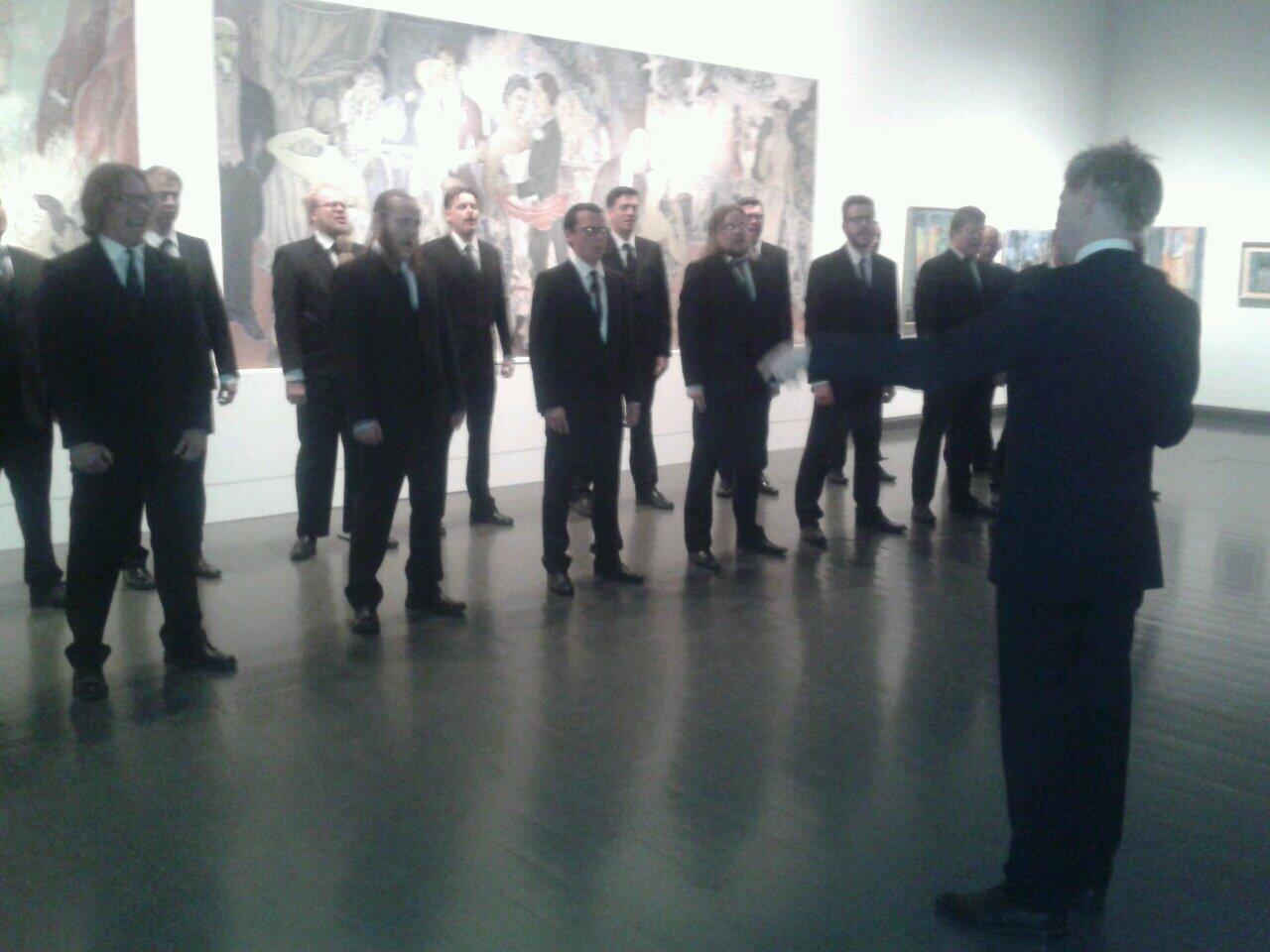


The Finnish Male Screaming Choir kicked things off with an amazing surprise performance at the top of the grand entrance of the museum. They then went on to perform within the galleries surrounded by the works of artist and Moomins illustrator Tove Jansson. It really was a great, fun start, which also allowed us all to mingle - it was also great to see so many registrars in one place!!
Wednesday, 4 June 2014
Our first blog post...
I'll keep this first entry short and look forward to the other blogs entries for #ERC2014 and future UKRG events. But just to say I'm delighted we have many positive responses from bursary winners who are happy to blog on the sessions at #ERC2014. I'm personally really looking forward to the 'Assessing Risk in Lending and Borrowing' session and in particular the 'Lending and Borrwering Scenario' talk by our UKRG Chair Jane Knowles and my Tate colleague Kate Parsons. On top of being such a great opporunity to meet so many reggies from the UK and Europe the #ERC2014 accessories are also getting me excited!!

Subscribe to:
Posts (Atom)